
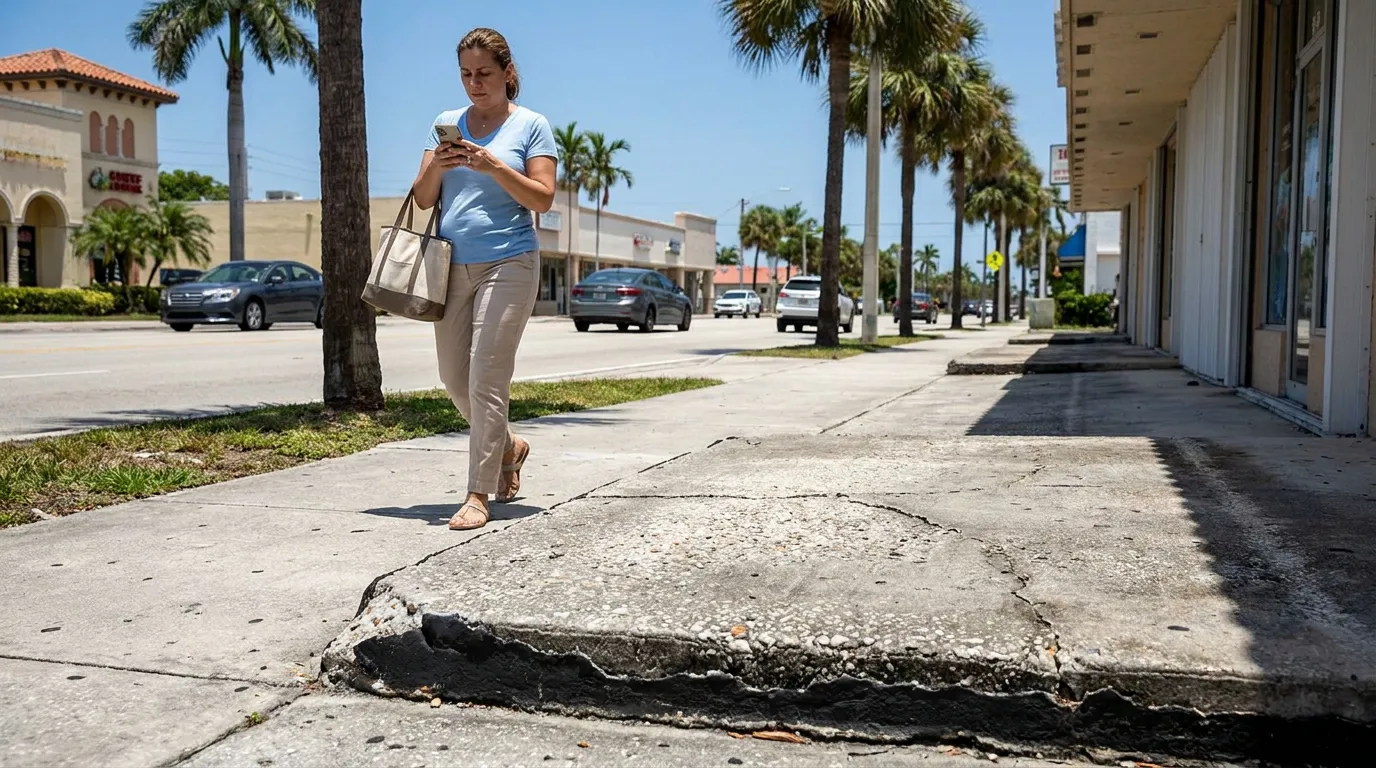
When a Visible Hazard Still Leads to a Valid Injury Claim in Hollywood
Key Takeaways: In Florida, a hazard being "open and obvious" is a defense argument, not an automatic bar to a Hollywood premises liability claim. Florida courts treat the doctrine as potentially negating the duty to warn while leaving intact the separate duty to maintain premises in a reasonably safe condition. The distraction exception recognizes that stores, hotels, and restaurants design spaces to draw customers’ attention toward displays and signage rather than the floor, making shopper inattention foreseeable. This principle survives because Fla. Stat. § 768.0755(2) expressly preserves common-law premises duties. Injured shoppers must prove the business had actual or constructive knowledge of the dangerous condition. Where visibility is disputed, Florida’s modified comparative negligence rule under Fla. Stat. § 768.81 often turns the issue into a percentage question for a jury, though a plaintiff found more than 50 percent at fault generally recovers nothing.
If you slipped on a spill or tripped over a pallet in a Hollywood store and an insurance adjuster told you the danger was "obvious," that response does not necessarily end your claim. Florida courts recognize a distraction exception, which acknowledges that businesses often design their spaces to pull a customer’s eyes toward merchandise, signage, and displays rather than the floor. When a property owner reasonably should expect shoppers to be distracted, hazard visibility may become one factor in comparative fault analysis instead of a complete bar to recovery.
If a store or hotel is blaming you for an injury on its property, the team at Salpeter Gitkin, LLP can review what happened. Call (954) 467-8622 or contact us now to discuss your options with a Broward County injury claim team.
What the Open and Obvious Defense Actually Argues
The open-and-obvious defense claims that a reasonable person would have seen and avoided the danger, so the property owner owed no duty to warn. Insurers raise it frequently in Hollywood FL premises liability matters because it shifts attention from the business to the injured customer. It is generally understood as a judicially created doctrine rather than statutory immunity, and Florida decisions have noted that it addresses the duty to warn without automatically eliminating the independent duty to keep property reasonably safe.
That distinction matters. Chapter 768 shows the Florida Legislature knows how to create explicit premises-liability presumptions when it chooses to, as it did in Fla. Stat. §§ 768.0705 and 768.0706, which grant presumptions against liability for specified security measures. No comparable provision addresses open and obvious conditions, leaving that defense largely to case law.
Visibility Is Not the Same as Legal Fault
A hazard being visible in hindsight does not necessarily mean the injured person was careless. Under Fla. Stat. § 768.81 (comparative fault), Florida allocates damages according to each party’s share of responsibility. Since the 2023 amendment, a plaintiff found more than 50 percent at fault is generally barred from recovering damages in a negligence action, while a plaintiff at or below that threshold has any award reduced by their percentage of fault. In many cases, an argument about hazard visibility becomes a percentage question for a jury rather than a dismissal.
How the Distraction Exception Fits Into Florida Slip and Fall Law
The distraction exception survives because Florida’s slip-and-fall statute expressly preserves common-law premises duties. Fla. Stat. § 768.0755(2) states that the section "does not affect any common-law duty of care owed by a person or entity in possession or control of a business premises." That language is why judicially created doctrines, including the duty to maintain premises in a reasonably safe condition and the distraction principle limiting the open-and-obvious defense, may continue to operate alongside the statute.
The statute itself was enacted in 2010 by s. 1, ch. 2010-8, replacing the prior burden-shifting framework. Readers can review the current version of the Florida statutes on damages directly.
Common Distraction Scenarios in Broward County Businesses
A distracted shopper fall often occurs in predictable places. Circumstances that courts may consider include:
- Endcap and promotional displays that draw a customer’s gaze upward and sideways
- Checkout lanes where signage, card readers, and employees compete for attention
- Grocery produce and freezer sections where condensation recurs near reflective flooring
- Hotel lobbies and resort walkways where wayfinding signs pull eyes away from wet tile
- Parking garages and entryways where a customer is managing a cart, bags, or children
💡 Pro Tip: Photograph the hazard and the surrounding display or signage from standing eye level. A photo showing what your eyes were drawn toward can be more persuasive than a close-up of the spill alone.
Proving an Open and Obvious Hazard Premises Liability Claim
Before the distraction argument arrives, an injured shopper must satisfy the statutory knowledge burden. Fla. Stat. § 768.0755(1) provides that a person who slips and falls on a transitory foreign substance in a business establishment "must prove that the business establishment had actual or constructive knowledge of the dangerous condition and should have taken action to remedy it."
Constructive knowledge may be established through circumstantial evidence. Under Fla. Stat. § 768.0755(1)(a)-(b), a plaintiff may show that the condition existed for such a length of time that the business should have known of it, or that the "condition occurred with regularity and was therefore foreseeable." That evidence frequently overlaps with proof that the hazard sat in a spot where customers are predictably distracted.
Beyond the statute, a slip-and-fall plaintiff must prove the four traditional negligence elements: duty, breach, causation, and damages. If you are weighing whether the defense applies to your situation, it may help to consult a lawyer familiar with how Broward County courts approach these disputes.
Why Visitor Status Shapes the Duty Owed
Florida premises liability often turns substantially on the visitor’s legal status. A shopper in a Hollywood retail store is generally a business invitee, owed a duty of reasonable care that may include inspecting for dangers the owner should discover and then repairing or warning about them. Guidance on slip and fall accident claims explains this tiered framework in plain terms.
Contrast that with Fla. Stat. § 768.075, which sets out narrow duties owed to trespassers. The statutory contrast reinforces the point: owners are generally expected to keep premises reasonably safe for lawful business visitors, not merely to avoid intentional harm.
| Issue | What the Defense Argues | What the Statute and Common Law Allow |
|---|---|---|
| Hazard visibility | The danger was plain, so no duty to warn | Visibility may be weighed as comparative fault under Fla. Stat. § 768.81 |
| Owner’s duty | Statute narrowed owner obligations | Fla. Stat. § 768.0755(2) preserves common-law duties |
| Notice | No proof the business knew | Constructive knowledge may be shown circumstantially |
| Customer attention | Shopper should have looked down | Distraction may be foreseeable given store layout |
Practical Steps That Strengthen a Distracted Shopper Fall Claim
What you do in the first days after a fall can shape what evidence remains available months later. Surveillance footage at many South Florida businesses is overwritten on a short cycle, and displays are frequently rearranged. Prompt action may help preserve the proof that supports both notice and distraction.
Consider the following steps:
- Report the incident to a manager and request a written incident report
- Seek medical evaluation promptly and follow through with recommended care
- Save the footwear and clothing you were wearing, unwashed
- Collect names and contact information for employees and witnesses
- Keep a dated record of symptoms, missed work, and out-of-pocket costs
💡 Pro Tip: Ask in writing that the business preserve video from the relevant time window. A documented preservation request can matter later if footage disappears.
Where Property Owner Negligence and Comparative Fault Meet
Even a strong defense argument about visibility may not produce a complete dismissal. Because Chapter 768, Part II governs comparative fault in negligence actions, a court may reduce recovery rather than eliminate it, subject to the statutory bar that applies when a plaintiff’s own fault exceeds 50 percent. Outcomes remain fact-dependent.
The notice inquiry may deserve as much attention as the distraction argument. Shifting focus to whether the business inspected, cleaned, and monitored foreseeable trouble spots addresses the owner’s conduct directly. A fall injury attorney reviewing your claim may examine inspection logs, staffing, and prior incident history.
Frequently Asked Questions
1. Does an obvious hazard automatically defeat my Hollywood claim?
Generally, no. Visibility is one factor courts may consider, and under Fla. Stat. § 768.81, it may more often affect damage allocation than eliminate a claim outright, unless a jury assigns the injured person more than 50 percent fault.
2. What is the distraction exception in simple terms?
It recognizes that a property owner may still owe a duty when it is foreseeable that a customer’s attention will be drawn away from the floor. Because Fla. Stat. § 768.0755(2) preserves common-law duties, this principle may continue to apply alongside the statute.
3. How can I prove the store knew about the spill?
Under Fla. Stat. § 768.0755(1)(a)-(b), constructive knowledge may be shown circumstantially through the length of time the condition existed or evidence that it recurred with regularity. Inspection records, video, and employee testimony often supply that proof.
4. Do these rules apply to hotels and restaurants too?
Generally yes, the statutory knowledge requirement applies to transitory foreign substances in business establishments, which may include Hollywood-area hotels, restaurants, and retail stores. Claims involving other hazards, such as defective stairs or poor lighting, are analyzed under ordinary common-law negligence principles.
5. What if I was partly looking at my phone?
That fact may be raised as comparative fault, and it does not necessarily bar recovery unless a jury finds you more than 50 percent responsible. Courts may weigh it against evidence of the owner’s failure to inspect and remedy a foreseeable hazard.
Protecting Your Rights After a Fall on Someone Else’s Property
An open and obvious argument is generally a defense position rather than a final ruling. Florida’s slip-and-fall statute sets a real burden on injured shoppers to prove actual or constructive knowledge, but it also expressly preserves the common-law duties that give the distraction exception its force. Understanding both halves of that equation, preserving evidence early, and acting within Florida’s applicable filing deadlines may give you stronger footing to pursue a fair result.
If a Hollywood business is pointing the finger at you after an injury on its premises, the attorneys at Salpeter Gitkin are ready to listen. Call (954) 467-8622 or schedule a consultation to have your claim reviewed.
Disclaimer: This content is for informational purposes only and is not legal advice. Every case is unique, and results may vary. Consult an attorney about your specific circumstances.